Pamela Hultgren / 2026.04
I began my study of Taiji Quan in 1996 and would not have considered myself a serious student, but classes were fun, interesting, and challenging. To be honest, I don’t think I really had any idea of what “good" Taiji was supposed to look like, let alone what it would feel like, until meeting Grandmaster Wu in 1997 when he, Shimu, and a group of senior students visited the US. I had no one-on-one contact with Grandmaster, but that meeting changed me. He was a presence.
I continued to attend classes, and my understanding began to change. I began to see that I had built much of my practice on holding—my body, my timing, my results, my mind. Then in 2006, I attended my very first international conference. That trip gave me a chance to immerse myself in Shen Long Taiji and to experience the fullness and camaraderie of Shen Long Taiji with Grandmaster Wu, his family, and senior brothers and sisters from around the world. I was surprised by how easy it was to be there, to just go along with the pace of the day, the pace of the classes, and even the pace of conversation, often completely in Chinese or through a willing translator.
During that trip, what struck me most about Grandmaster Wu was not a specific technique or explanation, but again the quality of his presence and approachability, a spirit that he fostered with and through all of his students.
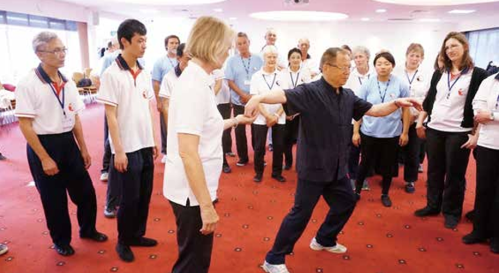
The very first morning in Taiwan, I met him in the coffee shop where he invited me to Push Hands. His movement was simple, unforced, and unmistakably alive. Mine was not. After only about a minute, he stopped and said, “No hips." I’d not heard that correction before, and certainly from Grandmaster it made a big impression. I can only assume that what he saw and felt was that all my movement were from the shoulders, no movement in the Kua, and no connection between the upper and lower body. That was the first of many, many corrections by Grandmaster and the other senior brothers and sisters. I paid close attention and took copious notes!
In preparing to write a few reflections about Grandmaster’s influence on me, I revisited my notes from that first trip almost 20 years ago. I was surprised to read the depth and timelessness of what was shared with me directly and through group talks. I am surprised at how much of this is part of me, a part of how I practice, and certainly how and what I teach.
From Master Wu’s Talks[original notes from 2006 trip to Taiwan
- Don’t do too much
- Don’t be greedy
- Work ten minutes a day to change your habits
- When observing, focus on one thing; do not try to see it all—you will miss the details
- The easiest things are the hardest to learn; we must practice the easiest things more
- It is very important to use the principles when practicing
- Practice T’ai Chi all the time, in everything
- The principles are there [in his book]; they are the truth
- Follow the principles; follow the method
- Don’t think too much
- If you put too much pressure on any one point, it becomes dead
- Students must practice more
- When we learn to move in T’ai Chi, first we move like wood, then like wood on the water, then like a ribbon, and ultimately like an eel
- Practice fewer things more
- Copy the root, do not copy the leaf [follow the principle, not the movement]
- Take care of the small movements
- Your mentality changes your habits—you should have no burdens in the mind
- Prepare before you practice; think light; make yourself light; check where your tension is; breathe naturally
- Don’t imagine. Do NOT imagine! Ask! If you do not understand a movement, ask [your teacher]
- When asked if we begin by concentrating, Master answered yes, but reminded us that it is like starting a car—you don’t continue to turn the key in the ignition—once it’s started, it’s started
- We must feed our fellow students; we must help fellow students
- Communicate with each other on a personal level
- You only need 4 square feet to practice T’ai Chi—even sword
Grandmaster Wu has left a mark on me and has left us all an incredible legacy. Cherish it; nurture it; honor it.
刊登於 2026 年《原幾》雜誌第九期

