Stephen Frost, Sydney Australia / 2026.04
Preface
The purpose of this article is to share my personal experience of transmission within an art such as Taiji Quan. I was among the first students from a Western cultural background to have the privilege of learning directly under Master Wu Kuo-Chung, and the journey that followed has shaped my understanding of both the art and myself in profound ways. What follows are my own reflections on the challenges and possibilities of cross-cultural transmission – how an art deeply rooted in Chinese culture can take root in another environment, and how teacher and student must work together to bridge the worlds they each inhabit.
Introduction
“Soft as a butterfly.”
That was the only way I could describe Master Wu’s touch the first time he issued fa jin on me. It was 1986, and the first moment I had met him. He was visiting Sydney, hosted by a well-respected Chinese martial arts teacher through the R.O.C. Kuo Shu Association. I had no connection to anyone at the class. I simply turned up out of curiosity, hoping to encounter something of the deeper layers of Taiji Quan that I had until then only read about.
A Long Search Before Meeting the Right Teacher
By that time, I had already spent decades immersed in martial arts. I began Judo at the age of twelve and continued throughout high school. Later, at university, Chinese-Malaysian friends introduced me to systems that, in 1970, were seldom taught outside the Chinese community. I was fortunate to be vouched for as a sincere practitioner and accepted into that world.
Over the following fifteen years, I studied Chinese martial arts under a number of teachers. Taiji Quan was among my interests, but I had never encountered anyone who could demonstrate the internal qualities described in the classical texts. What was often presented as ‘Taiji skill’ relied largely on refined balance and leverage – concepts I already understood well through Judo.
So, when I first felt the effortless, uncontrived quality of Master Wu’s power, I immediately knew this was something different.
At the time, I was thirty-five years old and at the peak of my martial conditioning. None of it prepared me for what followed. Master Wu asked me to take a strong forward stance, placing my right hand on his left shoulder. His right hand rested lightly on my abdomen. The next thing I knew, I was airborne – moving up and backwards at what felt like a forty-five-degree angle. There was no sense of impact, no pushing force. It fell entirely outside any framework of power issuance I had encountered in decades of training.
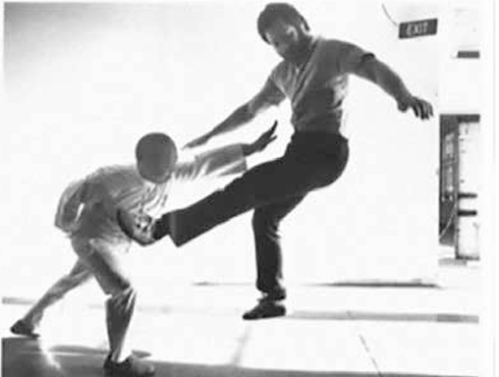
The second demonstration was even more incomprehensible. Several students were instructed to start banging their fists against the walls. I had no idea why, but I soon found out. Master Wu asked me to stand a few steps away from a brick wall with my arms folded. He gently placed his hands on my arms, and in the next instant my body slammed into the wall, about a foot above the ground. My body felt as though it were sinking into a mattress – compressed, elastic – yet it was clearly not the wall yielding under my weight. I had never been thrown so forcefully, even in my years of Judo.
Early Encounters and a Growing Connection
Master Wu’s stay in Sydney was brief, and he soon returned to Taiwan. I did not expect to see him again. However, a few years later he returned, and I was able to reconnect. Along with another student, I began training privately at his home whenever he visited Australia.
From the outset, he made it clear that copying external shapes was not enough. We had to understand why movements existed and how methods functioned. He constantly asked questions—not as interrogation, but as a way of gauging where our understanding genuinely rested. Our answers shaped the direction of his teaching.
At each session, he would ask what question I had brought that day. If the question was beyond my current stage of development, the answer would be brief. At other times, his response might last an hour. When I later asked him about this, he explained that the best questions arise naturally from one’s own practice. Those questions indicate readiness and support genuine progress.
I also came to understand that he was not interested in sophisticated or rehearsed answers. He wanted responses that came directly from embodied understanding. If I hesitated too long, he would stop me and say I was thinking too much. Much later, this reminded me of Yoda’s admonition to Luke Skywalker: “Don’t think – do.” For Master Wu, Taiji Quan was ultimately a martial discipline, and therefore a matter of life and death, not intellectual speculation.
The 1990 Indonesia Gathering: A Turning Point
In 1990, I attended the International Shenlong gathering in Indonesia. This proved to be a pivotal moment in my Taiji Quan journey. Meeting Brothers and Sisters from other countries, and witnessing the level of skill they had developed in relatively short periods, confirmed two things very clearly: Master Wu’s personal skill was exceptional, and he was also an exceptional teacher.
On returning home, I spoke candidly with my then-teacher. I explained that I wished to stop dispersing my efforts across multiple systems and instead pursue Taiji Quan in depth. I arranged a dinner between him and Master Wu. They spoke late into the night. Afterwards, my teacher simply said these words about Master Wu, “He is the real deal.”
As his own interests were broad, and not focused solely on Taiji Quan, we parted amicably. From that point on, my direction was clear.
The Slow Path to Becoming an Indoor Student
I asked Master Wu if he would teach me formally. He agreed, but a couple of years passed before I was accepted as an Indoor student after completing Ba Shi. Only later did I learn that he had reservations. He had never taught someone outside the Chinese cultural environment at the deepest level of the art. The question was not about physical ability, but whether the cultural ground required for genuine transmission could be bridged.
In retrospect, I came to understand that the many dinners, conversations, and long discussions were not incidental. They were deliberate. They were opportunities for mutual evaluation -exploring values, ethics, temperament, and worldview.
On one occasion, during a discussion about cross-cultural transmission, Master Wu observed that Chinese and Western cultures share many traditional wisdoms, often expressed through different metaphors shaped by daily life, history, and philosophy. A person deeply rooted in their own culture, he suggested, is better positioned to recognise and enter another.
We often exchanged traditional sayings and were struck by how closely aligned the underlying ideas were, even when the imagery differed. These shared moral and experiential foundations helped create a bridge between our worlds.
Crossing Cultures: The Art of Translating an Internal Tradition
Beyond Language
It is often assumed that language is the primary obstacle in cross-cultural transmission. In practice, vocabulary is the least significant barrier. Terms can be translated or explained over time. The greater challenge lies in the worldview that gives those terms meaning.
The internal arts emerged from a synthesis of Daoist philosophy, Confucian ethics, traditional Chinese medicine, martial culture, and centuries of embodied practice. Their core concepts rely heavily on metaphor, imagery, and lived experience – elements that do not align neatly with Western analytical frameworks.
Song is not ‘relaxation’.
Qi is not ‘energy’ as defined by Western physics.
An does not mean ‘Push’.
Yin–yang is not a static dualism, but a dynamic and continuously shifting relationship.
Without the cultural lens that informs these ideas, their internal mechanics are easily misunderstood.
I recall long discussions with Master Wu attempting to find workable English equivalents for certain terms. Song is a clear example. He warned that one of the great mistakes in Taiji Quan is collapse – something I was unknowingly doing. Like many Western practitioners, I had equated Song with relaxation, imagining the body collapsing into itself. This led to excessive yin and a loss of internal structure.
What I eventually understood was that Song refers to releasing unnecessary muscular holding while maintaining skeletal integrity. The flesh melts away, hanging from the frame, but the structure remains upright and open. This separation allows the fascia to engage. Muscle is a poor conductor of qi; fascia, when trained and thickened, becomes far more effective. Once this distinction became clear, my Taiji Quan progressed significantly. Of course, Song becomes a much deeper concept and experience over time but this was the first physical aspect as I understood it.
Transmission Is Embodied, Not Intellectual
Western education often prioritises the transfer of information. Internal arts function differently. They rely on embodied pedagogy (the method and practice of teaching, especially as an academic subject or theoretical concept).
Transmission occurs through touch, proximity, structural adjustment, timing, and personal presence. A student learns not only by understanding an explanation, but by feeling what the teacher demonstrates. This is why genuine transmission requires sustained time with a teacher – not merely learning forms, but aligning one’s nervous system with theirs.
Because of language limitations, Master Wu frequently relied on touch and demonstration. Sometimes, simply being in his presence carried a powerful transmission. He would often invite me to place my hands on his body to feel what words could not convey.
On one occasion, while teaching Da Cheng Fa and Shao Cheng Fa, he asked me to lightly hold his calf muscles. I felt a rippling, wave-like movement through the tissues – an experience far more instructive than any verbal explanation. On another occasion, he asked me to place my hands on his Dan Tian while he sat quietly. It felt alive and active, not contrived, but the natural result of decades of cultivation.
Character as the Foundation of Transmission
Traditional martial culture places great emphasis on qualities that are rarely foregrounded in Western training: sincerity, humility, steadiness, patience, and moral clarity. These are not abstract virtues; they are prerequisites for the internal path.
Internal training amplifies the heart-mind (xin). A teacher must assess whether a student is prepared to receive deeper material responsibly. For this reason, early relationship-building is essential. Transmission cannot occur without mutual trust and alignment of intent.
Master Wu often said that Taiji Quan is fundamentally a heart-mind cultivation art. Much later, he told me that what mattered most to him was what was in a person’s heart. Without this, no genuine transmission is possible.
Although it embarrassed me at the time, whenever he left Sydney, he would ask me to oversee the classes, despite there being others who were technically more skilled. His explanation was that I was closest to his way of thinking – to his heart-mind.
Bridging Worlds Through Shared Experience
When teacher and student come from different cultures, a third space gradually emerges. The teacher learns how to express traditional principles through new metaphors. The student learns to listen through the body rather than the intellect. This is not dilution; it is evolution. When handled carefully, the essence of the art remains intact while finding life in a new context.
When I first met Master Wu, he was a very traditional and uncompromising teacher. Taiji Quan, he said, was not a hobby, but a serious martial discipline. Outside training he was warm and approachable; during training he was strict and exacting.
In 1992, at a Shenlong gathering in Taiwan, I was struck by how formal and disciplined the training environment was. Students were highly deferential and rarely asked questions. Over time, while never compromising his principles, I observed a softening in Master Wu’s teaching manner. I believe this reflected his growing exposure to different cultural environments and his ability to adapt without losing the core of the art.
The Ongoing Journey
Cross-cultural transmission is delicate work. It requires patience, trust, and a willingness to build shared understanding over many years. For me, it began in 1986 with a touch that was soft as a butterfly – and it continues as both a personal practice and a lifelong relationship with Taiji Quan.


引用通告: 跨越世界的傳承:太極拳的跨文化之旅-輕靈若蝶 | 中華神龍太極學會